Achieving high mixer efficiency: the effect of AVI-MUL TOP GP10 on feed mixture uniformity (CV) and pellet quality.
Why is mixing process important in feed production?
The mixing process is crucial in feed production as it ensures uniform distribution of nutrients, additives, and other ingredients throughout the feed. Proper mixing guarantees that each pellet contains the same nutritional value and prevents segregation during processing and storage. Inadequate mixing can lead to imbalanced rations, resulting in low animal performance and potential health issues (Clark et al., 2007).
Which tool can be used to evaluate mixing efficiency?
A tool to evaluate how evenly the feed has been mixed is the coefficient of variation (CV) which reflects the uniformity of nutrient distribution in a feed mixture. A low CV, typically below 10%, indicates consistent blending of feed ingredients, which ensures animals receive the intended nutrient levels for optimal growth, health and production (Dunmire et al., 2021).
On the contrary, high CV values can lead to nutritional deficiencies, causing variability in animal performance. Monitoring and maintaining a low CV in feed production is essential to evaluate mixing equipment performance and process control, enhancing overall feed quality and consistency.
What influences the CV outcome?
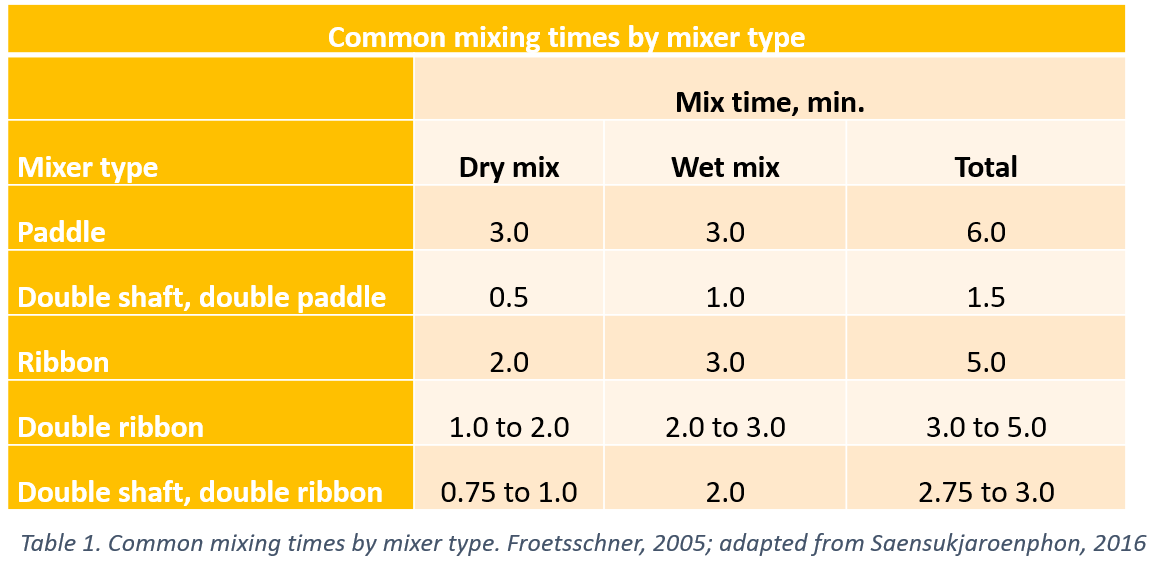
Mixing time and equipment type are critical factors of CV outcomes. The mixing process typically involves dry and wet mixing phases and varies by mixer types, with an average total length of 3-6 minutes (Table 1).
Ribbon mixers, while efficient in achieving faster mixing, can accumulate buildup if not routinely cleaned, compromising performance.
Paddle mixers, on the other hand, require longer mixing times but offer superior uniformity, particularly when properly maintained. Factors like batch size and mixer capacity also influence mixing efficiency.
Overfilled or underfilled mixers disrupt the blending process, while ingredient discharge points within the mixer can create dead zones, reducing overall homogeneity (Dunmire et al., 2021).
How feed ingredients impact on the CV value?
The physical and chemical properties of ingredients further affect CV. Larger or denser particles tend to settle during mixing, while lighter, adhesive, or electrically charged particles may stick to equipment, leading to uneven distribution. Ingredients such as molasses or fats can create buildup on mixer surfaces and even slight deviations in grinding can have important effects on CV.
The use of AVI-MUL TOP GP10 is an effective strategy to improve CV, particularly when liquid ingredients are involved. This patented emulsifier, by reducing surface tension, ensures an even dispersion of fats and liquid additives across the feed mixture, therefore preventing clumping or uneven coating, which are common issues that can lead to higher variability. Additionally, AVI-MUL TOP GP 10 reduces the build-up of oils and fats on mixer surfaces, enhancing mixing efficiency and keeping equipment performance optimally over longer periods.
Which actions can be taken to ensure proper mixing and high feed quality?
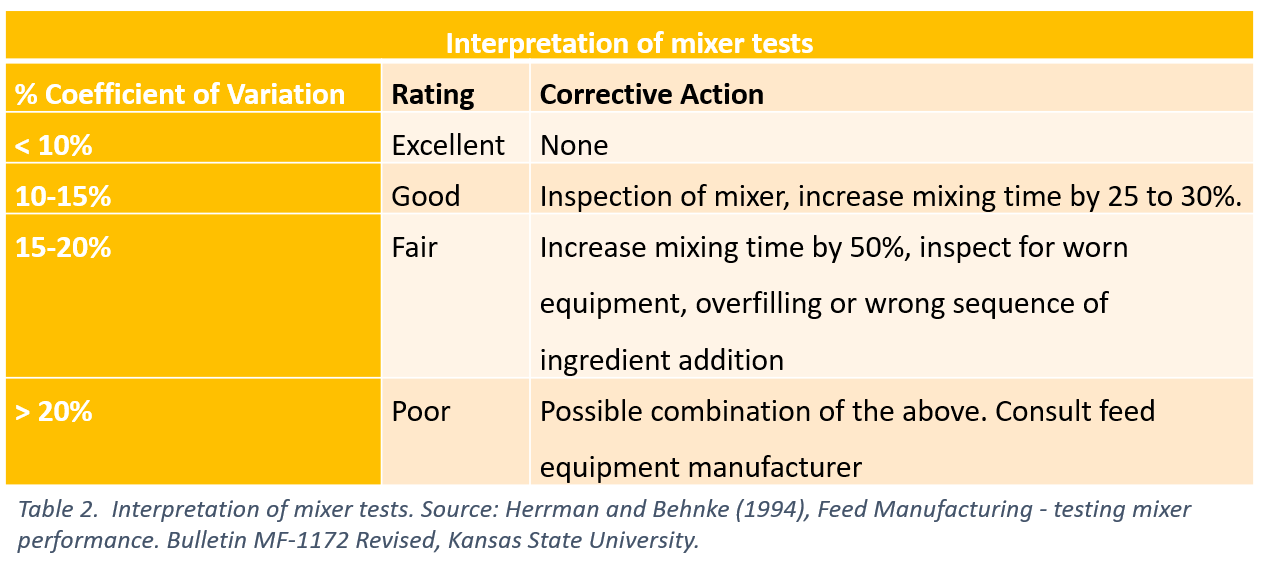
To ensure consistent feed quality, manufacturers should give particular attention to ingredients sequencing, mixer maintenance, and batch testing. Ingredients should be added in a specific order—major components first, followed by minor, micro, and liquid ingredients—to facilitate proper blending. Regular CV evaluations are essential for identifying mixing inefficiencies. When test results indicate poor mixing, corrective actions are necessary (Table 2).
The addition of AVI-MUL TOP GP10 helps to quickly combine liquid and dry particles,reducing the time to achieve a homogeneous mix and increasing production efficiency. Moreover, after mixing, feed can experience ingredients segregation due to different density or particle size. By cohesively binding ingredients, AVI-MUL TOP GP10 reduces their separation during the following production steps, storage and transport. This ensures consistent CV and quality through the entire feed production chain.
In conclusion, how to maximize the mixing process?
CV is a vital indicator of feed quality, reflecting the success of the mixing process. Through close attention to equipment, ingredients and testing, feed manufacturers can achieve low variability and high feed efficiency
Moreover, by ensuring a proper dispersion of fats and liquid in the mixture, AVI-MUL TOP GP10 promotes homogeneity of feed, with an optimum and consistent CV value.
Contact us to receive more information on how to improve the mixing process and discover more benefits of AVI-MUL TOP GP10!